Supreme Court PIL on Contaminated Cough Syrups Sparks Nationwide Outrage and Pharma Reckoning
In a development that has sent shockwaves through the pharmaceutical sector and raised public consciousness, the Supreme Court of India has agreed to urgently hear a Public Interest Litigation (PIL) regarding multiple deaths linked to contaminated cough syrups. This PIL comes in the wake of mounting casualties and international scrutiny, as several recent incidents have highlighted critical lapses in drug safety standards.

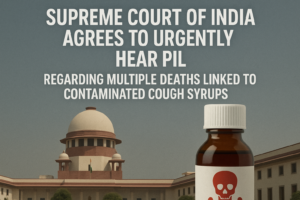
The outcry began when disturbing reports surfaced from various Indian states, citing cases where children and adults fell gravely ill—and some tragically died—after consuming contaminated cough syrups. What initially seemed like isolated incidents quickly evolved into a public health crisis, exposing critical lapses in drug safety standards. The toxic cough syrup deaths not only devastated families but also ignited widespread public anger and global concern about the quality of Indian pharmaceuticals.
As investigations unfolded, health authorities across the globe, including the World Health Organization (WHO), began issuing alerts, urging countries to exercise caution with Indian-manufactured cough syrups. This growing international scrutiny has shaken confidence in India’s otherwise robust pharmaceutical industry, often hailed as the “pharmacy of the world.”
In response, the Central Drugs Standard Control Organization (CDSCO)—India’s top drug regulator—announced an immediate nationwide audit of all cough syrup manufacturing units. This unprecedented initiative under the Drugs and Cosmetics Act, 1940, seeks to re-examine product quality, enforce stringent pharmaceutical safety standards, and ensure that medications reaching consumers are safe and effective. Inspectors have begun visiting manufacturing facilities, reviewing testing protocols, and examining supply chains to identify where oversight may have failed.
For many pharma companies, this is a moment of reckoning. The possibility of mass product recalls, legal accountability, and judicial scrutiny has sent shockwaves through the sector. Industry experts warn that the implications could ripple far beyond a single drug category, necessitating a comprehensive overhaul of manufacturing practices, regulatory enforcement, and corporate compliance.
At the heart of the storm lies a Public Interest Litigation (PIL) that has reached the Supreme Court of India. The Court’s decision to urgently hear the matter underscores the seriousness of the crisis. Petitioners argue that systemic regulatory failure, delayed response by authorities, and weak enforcement of Good Manufacturing Practices (GMP) have endangered countless lives. The case has revived long-standing debates about transparency, accountability, and the urgent need to reform India’s drug regulatory framework.
Activists and health experts are calling for stronger monitoring, independent audits, and public disclosure of test results to restore trust. They emphasize that vulnerable populations—particularly children and the elderly—must never again be placed at risk due to negligence or corporate malpractice.
Meanwhile, media outlets, social networks, and public health forums are amplifying the conversation, turning the issue into a national talking point. From major cities to small towns, people are questioning how such lapses could occur in a country that prides itself on being a global pharmaceutical leader.
In this atmosphere of urgency and uncertainty, India stands at a critical crossroads. The outcome of the Supreme Court’s directive could determine the future of drug regulation in the country. Will this landmark judicial intervention expose deeper cracks in the system—or inspire sweeping reforms that set new global benchmarks for drug quality, safety, and corporate responsibility?
As the world watches closely, one thing is clear: the decisions made in the coming weeks will shape not only India’s pharmaceutical reputation but also the trust of millions of patients who depend on its medicines every single day.
Peeling back the layers, one can’t help but ask—how did this tragedy slip through the cracks despite regulatory checks? Was it a matter of oversight, or something far more troubling rooted in systemic negligence? The answers may not just shape policy but redefine trust in India’s healthcare apparatus.